Do you not have the Username and Password to access the Order Area?
Do you wish to place an order?
In hydraulic systems, the connection standard used to connect hoses, cylinders and valves is far from a minor detail: it directly affects sealing performance, component compatibility and the overall safety of the circuit.
BSP, DIN 24°, JIC and ORFS are among the most widely used connection standards, but they differ in terms of geometry, sealing systems and applications.
Understanding these differences is essential for correctly identifying a fitting and selecting the standard best suited to the requirements of the hydraulic system.
BSP, DIN 24°, JIC and ORFS originate from different regulatory frameworks and markets and feature specific design characteristics. Understanding the thread type and sealing principle of each standard is the first step towards correctly identifying a fitting and selecting the most suitable solution for a hydraulic system.
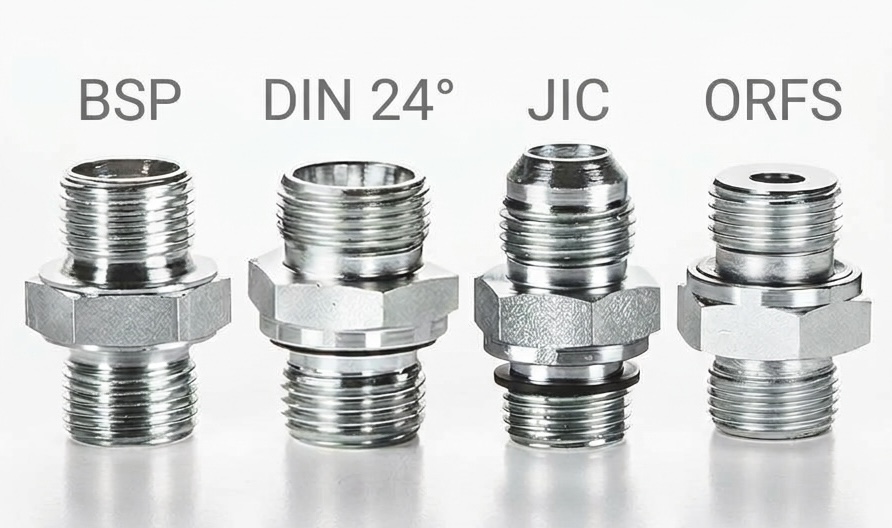
BSP (British Standard Pipe) is a British-origin standard widely used in Europe for hydraulic and industrial applications. It includes two main thread types:
BSP adapters for hydraulic applications are available in a wide range of configurations and are designed to provide reliable connections, including in high-pressure hydraulic systems. The appropriate configuration depends on the type of connection and the sealing system required by the application.
BSPT remains one of the most widely used thread types in the European hydraulic industry, while BSP adapters are used in a variety of applications, including industrial systems, earthmoving machinery and high-pressure hydraulic systems.
For more information, explore our range of BSP adapters.
DIN 24° is one of the most widely used connection standards in Europe for hydraulic applications. It refers to DIN 2353 and ISO 8434-1 and uses a 24° cone connection, widely adopted in European hydraulic circuits.
Sealing takes place between the 24° conical seat of the male fitting and the corresponding sealing surface of the female fitting. In cutting-ring connections, the system also provides a secure mechanical connection to the tube.
The DIN system is mainly available in two series:
DIN 24° adapters are used in industrial machinery, mobile equipment, hydraulic cylinders and OEM applications, providing a reliable connection even under demanding operating conditions involving high pressures and vibration.
For more information, explore our DIN 24° adapters.
JIC 37° is an American-origin connection standard widely used in North American markets and in hydraulic applications involving earthmoving machinery, off-road equipment and agricultural machinery. The connection features straight threads and a 37° flared seat on both the male and female sides.
Sealing is achieved through metal-to-metal contact, without the use of additional seals. During tightening, the nut forces the fitting’s flared surface against the mating cone, creating the deformation required to achieve reliable sealing.
The JIC standard is particularly suitable for high-pressure hydraulic lines and applications exposed to demanding operating conditions. JIC adapters are available in a variety of configurations and allow components with different thread types to be connected according to the requirements of the hydraulic system.
Discover all the available configurations in our range of JIC 37° adapters.
The ORFS (O-Ring Face Seal) connection standard is particularly valued in hydraulic applications where high sealing performance and resistance to vibration are required. The system features a male fitting with an O-Ring positioned in a groove on the flat face, which is compressed against the flat face of the female fitting during tightening.
The sealing principle therefore relies on O-Ring compression, rather than direct metal-to-metal contact between the sealing surfaces. The female fitting features a flat face and a swivel nut with a UNF thread, while the O-Ring on the male fitting remains easily accessible, making it easier to inspect its condition during maintenance.
The main advantages of the ORFS system include:
Thanks to these characteristics, ORFS fittings are increasingly used on OEM machinery for international markets, particularly where high levels of sealing performance and reliability are required under demanding operating conditions.
For more information, explore our ORFS adapters.
One of the most common mistakes when selecting or replacing a fitting is to assume that connections are interchangeable simply because they appear similar in terms of dimensions, even though they may use different threads, geometries and sealing systems. A visual resemblance or the fact that two components can be partially threaded together is not enough to ensure a safe connection.
Some cases can be particularly misleading:
Using components from different standards without verifying their compatibility can result in poor sealing, fluid leakage, damage to sealing surfaces and, in more critical cases, hydraulic system malfunctions. Before replacing a fitting, it is therefore essential to correctly identify the original thread, sealing geometry, sealing system and connection dimensions.
Correctly identifying the connection standard is therefore not simply a matter of dimensions: the entire connection system must be checked before proceeding with a replacement.
The choice of connection standard should not be based solely on fitting size. It is important to consider the type of machinery, the manufacturer’s specifications and the actual operating conditions of the hydraulic system. A complete assessment helps identify the most suitable connection and reduce the risk of leaks, failures and machine downtime.
The first aspect to check is the standard specified by the machine or system manufacturer. The target market can also influence the choice of connection: BSP and DIN 24° are particularly widespread in European applications, while JIC and ORFS are widely used on machinery designed for international and North American markets.
When replacing a fitting, it is therefore important to maintain the original standard unless the manufacturer explicitly specifies an alternative solution.
The connection standard must be assessed together with the system’s operating conditions. Working pressure, pressure spikes, temperature, vibration, movement and cycle frequency can all affect the choice of fitting and sealing system.
For a more comprehensive assessment, it is important to consider pressure, temperature and operating conditions in the hydraulic system before selecting the most suitable fitting.
Finally, it is important to consider how critical fluid leakage is for the application. In systems particularly exposed to vibration or high pressure, or where leakage could compromise machine operation, it is essential to select a sealing system suited to the actual operating conditions.
The choice of the right connection standard should therefore take into account the manufacturer’s specifications, pressure, temperature, operating conditions and sealing requirements, rather than being based solely on dimensional compatibility.
Choosing the right connection standard is essential to ensure the reliability, sealing performance and safety of a hydraulic system. BSP, DIN 24°, JIC 37° and ORFS meet different requirements and should be selected according to the characteristics of the application, the manufacturer’s specifications and the operating conditions.
Correctly identifying the connection standard and fitting characteristics helps prevent compatibility issues and identify the most suitable solution, including for replacement and maintenance operations.
Need more information or support in choosing the right solution? Fill out our contact form and send us your request: our team will assess your requirements.


